Updated August 2026
LazeeFish vs Actual Budget
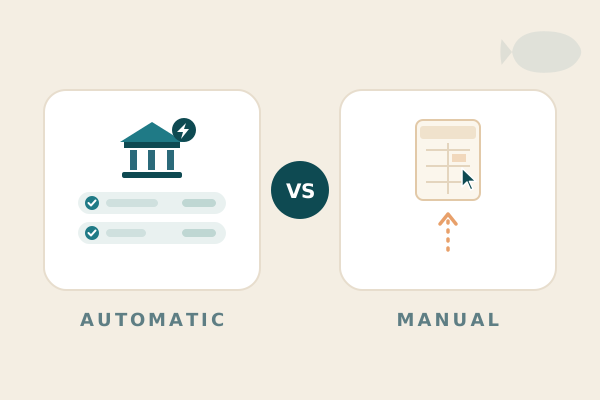
Both use zero-based budgeting. Both assign every dollar. The difference is what happens after that — automatic or manual, hosted or self-hosted, $5/month or free.
An envelope budgeter with automatic Plaid bank sync, AI auto-categorization, joint budgets, and recurring bill tracking. Every feature included at $5/month or $50/year.
An open-source envelope/zero-based budgeting app with no paid tier at all — you host it, on your own machine or a provider of your choice. It does have built-in bank syncing, via SimpleFIN in the US and Canada and GoCardless in the EU and UK. Strong community; technically oriented.
Same method, very different automation
Both apps use zero-based budgeting — assign every dollar of income to a category before you spend it. That common foundation means switching between them is mostly a data-migration problem, not a methodology problem.
The meaningful difference is automation. LazeeFish connects to 12,000+ US banks via Plaid and automatically imports, deduplicates, and categorizes your transactions in the background. Actual Budget requires you to import transactions manually — either via CSV from your bank or via occasional manual entry.
For some people, that manual ritual is the point: every transaction you touch is a transaction you notice. For others, it's a friction that leads to falling behind. Neither is wrong, but it's the most important thing to know before you choose.
| Feature | LazeeFish | Actual Budget |
|---|---|---|
| Pricing | ||
| Monthly cost | $5 | $0 — you provide hosting |
| Annual cost | $50 | $0 — you provide hosting |
| Official hosted plan | Yes — we host it | None — theirs closed in 2024 |
| Free trial | 30 days, no card | Self-hosted is always free |
| Budgeting approach | ||
| Zero-based / envelope budgeting | Yes — core method | Yes — core method |
| Proactive dollar assignment | Yes | Yes |
| Monthly allocation automation | Yes | Manual |
| Budget rollover | Yes | Yes |
| Bank sync & import | ||
| Automatic bank sync | Yes — Plaid, built in | Yes — SimpleFIN (US/CA), GoCardless (EU/UK) |
| Sync set-up | Connect and go | You configure the provider yourself |
| Extra cost for sync | None — in the $5 | SimpleFIN is a separate paid service |
| Transaction categorization | Learns per merchant, with a confidence score | Rules you write |
| CSV import | Yes | Yes |
| Manual transaction entry | Yes | Yes |
| Platform | ||
| Web app | Yes | Yes |
| Native mobile app | Mobile web / PWA | Mobile web only |
| Self-hosted option | No | Yes (open source) |
| Collaboration | ||
| Joint / household budgets | Yes — included | No built-in multi-user |
| Separate partner logins | Yes | No |
| Privacy | ||
| Sells / shares your data | No | No (especially if self-hosted) |
| Open source | No | Yes (MIT) |
| Extra features | ||
| Debt tracking with P&I split | Yes — included | Basic |
| Recurring bill tracking | Yes — included | Basic |
| Savings goals | Yes — included | Yes |
| Subscription auto-detection | Yes | No |
| AI categorization | Yes | No — manual rules only |
Every competitor claim on this page is checked against the vendor's own pricing and documentation, with sources and dates recorded. Prices and features still change — if something here looks wrong, tell us and we'll fix it.
Where LazeeFish wins
- Automatic bank sync. Plaid connects to 12,000+ US banks and imports transactions in the background. With Actual Budget, you manually export CSVs from your bank and import them. If you fall behind by two weeks, you're sorting through 50 transactions by hand.
- AI auto-categorization. LazeeFish learns your merchants and categorizes new transactions automatically. Actual Budget uses manual rules you set up yourself — powerful for power users, time-consuming for everyone else.
- Zero setup. Open the app, connect your bank, create envelopes. No server, no CLI, no updates to manage. Actual Budget's self-hosted version requires comfort with running a local process and handling your own updates.
- Joint budgets. LazeeFish supports multiple logins with shared and private envelopes for couples or households. Actual Budget has no built-in multi-user collaboration.
- Recurring bill tracking and debt management. Actual Budget tracks spending against budgets. LazeeFish's recurring bills module auto-fulfills from bank imports, and the debt tracker auto-splits payments into principal and interest using your balance and APR.
- Support. LazeeFish has a dedicated support team. Actual Budget is community-supported via Reddit and Discord.
Where Actual Budget wins
- Price. The self-hosted version is free. Permanently. LazeeFish costs $5/month or $50/year. If the YNAB method resonates but a subscription doesn't, Actual Budget's free tier is the honest answer.
- Self-hosting and privacy. Your data lives on your own server — not any company's cloud. For users who are uncomfortable with a third party holding financial data, self-hosting is a meaningful advantage.
- Open source transparency. The code is public and auditable. You're not trusting a black box with your transaction history.
- Free, with no vendor to depend on. No subscription at any tier, MIT licensed, and if we or anyone else stopped operating tomorrow your budget keeps working. That is a real advantage and we have no equivalent.
- Extensibility. Developers can modify Actual Budget directly. LazeeFish is a closed SaaS product.
How to choose
Choose LazeeFish if: You want zero-based budgeting to mostly run itself, without operating any of it. Both apps can sync a bank; the difference is that ours is set up for you and included in the price, where Actual expects you to stand up a server and wire up a sync provider — and pay that provider separately. If "host it yourself" reads as work rather than a feature, that's the trade.
Choose Actual Budget if: You want the same method for nothing, and you're comfortable running it yourself — there is no official hosted plan to buy since theirs closed in 2024. Choose it if you value open-source auditability, want your data entirely off third-party servers, or would rather not depend on any vendor staying in business. The community is active and helpful.
Honest note: If you've tried budgeting apps before and always fell off after a few weeks of manual entry, choose the one with automatic sync — either LazeeFish or YNAB. The best budget is the one you actually maintain.
One thing to know about how LazeeFish is built: it does envelope budgeting and nothing else. There is no 50/30/20 mode, no flexible spending plan, and no way to change method without changing apps. That is a deliberate choice rather than a missing feature — if you have drifted out of envelope budgeting before, a tool with no fallback is the point. But it is a real constraint, and if you would rather have one app that can change approach as your life changes, weigh that before you switch.
Start your 30-day free trial
30-day free trial. No card to start. Connect a bank and create your first envelopes in minutes.
Start free trial See pricing