Updated May 2026
Everything about
envelope budgeting,
in one place.
Seven articles, in the order that makes the most sense. Takes about 45 minutes total. Read them all, or just start at the one that matches where you are.
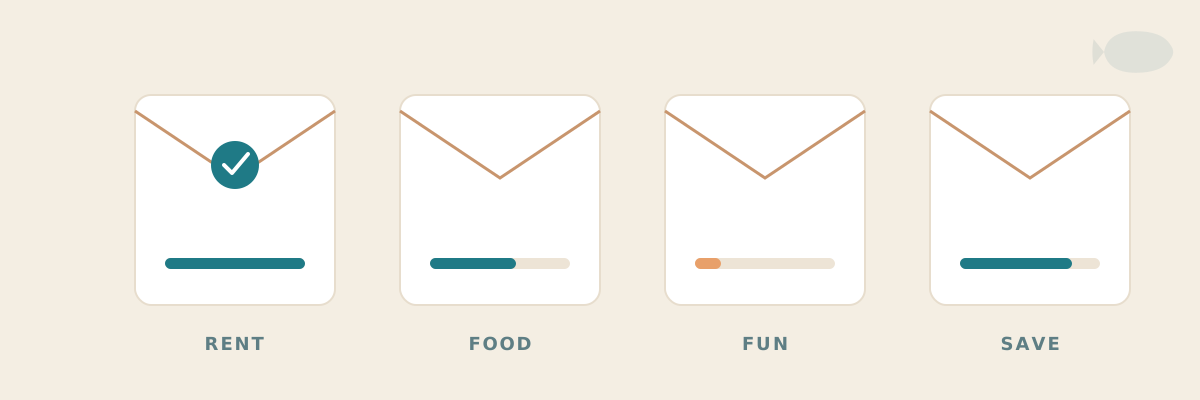
The simplest budget that works.
Envelope budgeting is a cash-allocation system. Before the month starts, you divide your income into named categories — a virtual envelope for groceries, one for dining out, one for gas, one for rent — and every dollar has a home. When an envelope runs empty, spending in that category stops.
The original method used literal cash placed in physical envelopes. You'd pull from the grocery envelope at the store, and when the cash was gone, you stopped buying groceries until next payday. Brutally simple. Remarkably effective. Cash stuffing is the modern physical variant — people still do it today with labeled envelopes or decorated pouches.
Digital envelope budgeting works identically, but your envelopes live in software. Bank sync imports your transactions automatically. Each purchase depletes the right envelope in real time. You see exactly how much is left in every category before you swipe your card.
The core insight — and the reason this system works when other methods fail — is that it changes the felt experience of spending. An empty envelope isn't a warning. It's a hard stop. That structural constraint is what the research on spending behavior confirms: visible limits at the point of decision change behavior in a way that summary reports viewed later never can. Read the full science in The Brain Science of Cash Stuffing.
Other budgets tell you what happened.
Envelopes shape what happens next.
Most budgeting methods are reporting tools. They show you how much you spent last month. They tell you that you went $80 over on dining out in March. They do not stop you from going $80 over in April.
Envelope budgeting is a constraint tool. You allocate $300 to dining out at the start of the month. When $300 is gone, the constraint is active — not in a report next month, but right now. That timing difference is everything. Read more in Your Budget Is Lying to You.
A second reason: envelope budgeting forces you to confront trade-offs explicitly. When the dining envelope is empty but you want to eat out, you have to consciously move money from another envelope. That deliberate decision — "I'm taking $40 from clothing to cover this dinner" — is the moment of financial awareness that drives lasting habit change. You know exactly what you're choosing to sacrifice.
The recommended
reading order.
New to envelope budgeting? Read top to bottom. Already know the basics? Jump to whatever's relevant.
The envelope method, explained.
A 100-year-old budgeting system, why it still works, and how to run it on autopilot. The complete overview — start here if you're new.
Your budget is lying to you.
Why tracking-based budgets feel accurate but consistently fail — and what envelope limits reveal that spreadsheet rows can't.
The brain science of cash stuffing.
Why physical limits trigger a different neural response than digital tracking — and how that changes your actual spending behavior.
How to start envelope budgeting.
A concrete, no-fluff walkthrough of your first 30 days — which envelopes to create, how much to allocate, and what to do when you overspend.
Envelopes vs. every other budgeting method.
Zero-based, 50/30/20, pay yourself first — how they all stack up against envelopes on real-world results and long-term sustainability.
Envelope vs. zero-based budgeting.
Two methods that sound nearly identical but feel completely different in practice. Here's exactly where they diverge — and which one sticks.
90 days in: what actually changes.
A candid look at what envelope budgeting feels like after three months — the real wins, the friction points, and the surprises nobody tells you about.
Not everyone's
starting from the same place.
Budgeting with a wobbly paycheck.
The two-month rule for freelancers, contractors, and anyone whose income varies month to month.
Budgeting together without the arguments.
How to share envelopes without sharing resentment — a framework for joint finances that actually works.
Budgeting when you're doing it alone.
How to make envelopes work when you're the only income earner and the only adult in the room.
Frequently asked questions.
Do I have to use cash? +
No. The cash version is the original, but digital envelope budgeting works identically. You track balances per category in software, connect your bank for automatic transaction imports, and see exactly what's left in each envelope at any moment — without handling physical cash. The constraint is the same; only the medium changes.
How many envelopes should I start with? +
Start with 8–12. Fewer than 8 and you lose the category-level visibility that makes envelopes useful. More than 15 and the monthly allocation becomes a chore that most people eventually abandon. A good starter set: rent/mortgage, groceries, dining out, gas/transport, utilities, subscriptions, personal care, clothing, savings, and one or two envelopes for your biggest discretionary categories. You can always split envelopes later as you learn your patterns.
What if my income is irregular? +
Irregular income is actually easier to manage with envelopes than with a fixed-income budget. The key technique is to set your monthly salary based on your lowest recent income month — not your average. Any income above that baseline flows into a buffer envelope. You pull from the buffer in slow months, replenish it in good ones. Your envelope allocations stay stable even when your deposits vary. See the full approach in Budgeting with Irregular Income.
Can couples use envelope budgeting together? +
Yes — and it often works better for couples than solo because it makes shared financial decisions explicit. Both partners see the same envelope balances. When the dining envelope hits zero, neither person has to "guess" where the month went. LazeeFish supports joint budgeting natively: both accounts share the same household, envelopes, and transaction feed. Separate personal envelopes with private visibility are also supported for discretionary spending each partner manages independently.
Read enough?
Try it for free.
Connect a bank, create your envelopes, and see your first auto-categorized transaction by tomorrow.
Create free account→