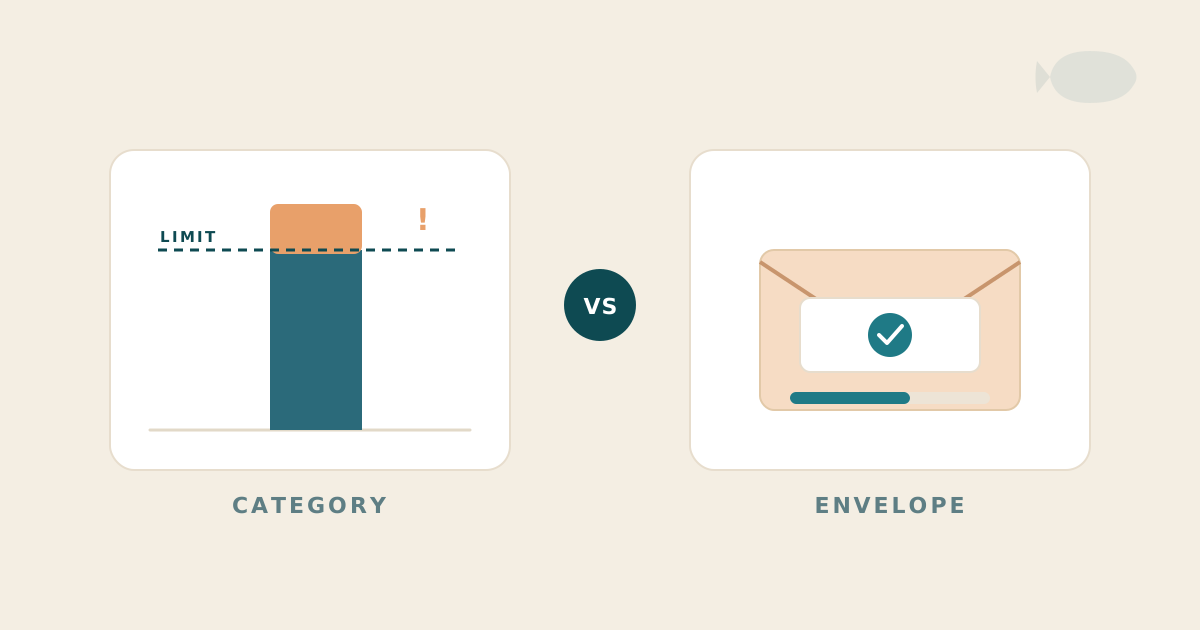
Both methods look similar from the outside. You open an app, you see categories: Groceries, Dining, Gas, Subscriptions. There are numbers next to them. Something turns red when you go over.
But structurally, they're doing completely different things — and that structural difference is the entire explanation for why one changes behavior and the other doesn't.
Category Budgeting: What It Is
Category budgeting sets a monthly spending limit per category and tracks your actual spending against it as the month progresses. You spend first, the app records it, and a progress bar fills up toward your limit.
You're always spending forward. The category limit is a ceiling you're approaching. You find out you've hit it after you've already spent — at the end of the month, or when a notification fires.
This is how most budgeting apps work. Monarch's "flex budgeting," Copilot's category limits, and Rocket Money's spend tracking all operate this way. Track first, alert second.
Envelope Budgeting: What It Is
The envelope method inverts this sequence entirely. Before the month begins, you allocate a specific, fixed amount to each category. That allocation is the envelope. As you spend, that pool depletes.
You're not tracking toward a ceiling. You're drawing down a finite pool. The question is never "how close am I to my limit?" — it's "how much is left?"
When the envelope is empty, you stop. Not because an app sent a warning — because there's nothing left to spend.
The Key Difference: Timing of the Decision
Category budgeting lets you spend first and reflect second. The decision — "how much is reasonable to spend here?" — never actually happens. You set a limit at the start of the month, possibly, but the spending decision in the moment isn't anchored to anything. You're just moving toward a cap you may or may not hit.
Envelope budgeting forces the decision before any spending occurs. At allocation time, you ask: "How much groceries money do we actually have this month?" That question is real — the answer is a specific dollar amount that you commit to. Every purchase after that is drawing down a pre-committed pool.
Category budgeting shows you how much you've spent. An envelope shows you how much is left. That's not the same thing.
The "Spending Brake" Mechanism
There's a behavioral difference between abstract constraints and concrete ones. A category limit that says "you've spent $187 of your $250 groceries budget" is abstract — $63 is a number, not a felt sense of remaining resources.
An envelope that contains $63 — and nothing else — is concrete. When you open it, you see what's there. The constraint is tangible.
Research on mental accounting (Thaler, 1985) shows that people treat money differently based on which mental account it's in. Earmarked money — money pre-committed to a specific purpose — generates more spending resistance than fungible money. An envelope implements mental accounting at its most literal: the money is physically or digitally separated before you spend it.
That separation is the spending brake. Not a notification. Not a bar turning red. A finite pool that visibly depletes.
Research consistently shows this range when controlling for income. The effect is largest in the first six months of adoption as new spending habits form.
Why Monarch's "Flex Budgeting" Is Category Tracking
Monarch Money is well-designed and genuinely useful for understanding your finances. But its core budgeting feature — "flex budgeting" — is category tracking with a modern interface. You set monthly spending limits. Transactions flow in and fill up the bar.
What's absent is the pre-commitment. Monarch doesn't ask you to allocate a specific pool of money before the month starts. It asks you to set a limit after you've already started spending — and then it tells you how close to the limit you are.
For behavior change, that sequence matters. The decision has to happen before the spending, not alongside it.
Why YNAB Works (and Why It Takes 30+ Minutes a Week)
YNAB (You Need a Budget) uses genuine envelope allocation — every dollar gets assigned to a category before spending begins. This is why YNAB users consistently report the largest behavior changes of any budgeting app.
The drawback is the manual work. YNAB auto-approves imports it can match, so the review queue is the unmatched ones; you still adjust allocations by hand when you overspend, and regularly "roll with the punches" by moving money between categories. For people with complex finances or a lot of transactions, this can easily become a 30–45 minute weekly exercise.
That's not a flaw in the philosophy. It's a friction cost that, for many people, eventually causes abandonment — which wipes out all the behavior change they'd built.
How AI Auto-Categorization Closes the Gap
The behavioral mechanism that makes envelopes work — pre-committed pools that deplete as you spend — doesn't require manual transaction entry to function. It requires accurate, automatic categorization so the envelope balances update without intervention.
This is what AI auto-categorization actually solves. Not a gimmick — a friction eliminator. When every transaction is automatically sorted to the right envelope, the pre-commitment mechanism runs passively. You allocate once at the start of the month. The AI handles the categorization. Your balances stay accurate without you touching anything.
The decision that changes behavior (allocation) happens. The work that causes abandonment (manual transaction entry) disappears.
Both approaches involve categories. But category budgeting is passive — you set limits and observe how close you get. Envelope budgeting is active — you commit real money in advance and spend from a finite pool. The word "budgeting" covers both, which is why people switch from one to the other without realizing they've fundamentally changed their system.
Side-by-Side Comparison
| Category Budgeting | Envelope Budgeting | LazeeFish | |
|---|---|---|---|
| When decision happens | After spending starts | Before month begins | Before month begins |
| What happens at the limit | Red bar, optional alert | Envelope is empty | Envelope is empty |
| Time per month | Weekly reviews | 30+ min (manual) | ~10 min (AI handles rest) |
| Learning curve | Low | High | Low |
| Behavior change | Low — reactive | High — proactive | High — proactive |
If you want to understand more about the broader difference between tracking and budgeting, that's worth reading too. The category vs. envelope distinction is one layer of it — but the tracking vs. budgeting question is even more fundamental.
Envelope budgeting without the spreadsheet. $5/month. 30-day free trial.
Start Free →Frequently Asked Questions
Is zero-based budgeting the same as envelope budgeting?
They're related but not identical. Zero-based budgeting is the philosophy — assign every dollar a purpose until income minus allocations equals zero. Envelope budgeting is one concrete implementation. You can do zero-based budgeting without envelopes, but envelopes are the implementation that makes the behavioral change stick because they create a visible, finite limit at the category level.
What does Monarch Money use — envelopes or categories?
Monarch uses "flex budgeting" — a category-tracking approach where you set monthly limits and track spending against them. This is category budgeting, not envelope allocation. There's no pre-committed pool of money that depletes. That structural difference is why Monarch works better for understanding your finances than for actively changing spending behavior.
How long until envelope budgeting shows results?
Most people see a meaningful shift in 30 days and durable behavior change by 90. The first month feels restrictive as you calibrate your envelopes to your actual spending patterns. By month two it feels familiar. By month three the structure has internalized as a decision-making habit.