Updated June 2026
LazeeFish vs Dollarwise
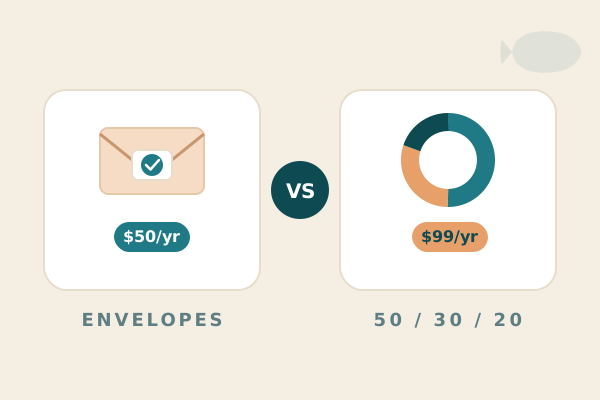
Both apps connect to your bank via Plaid and help you manage spending. But the methods are different — Dollarwise uses 50/30/20 broad buckets; LazeeFish uses envelope budgeting where every dollar gets assigned a specific job. And there’s a $49/year price difference.
Envelope budgeting with Plaid bank sync, AI auto-categorization, monthly allocation automation, joint budgets, and debt tracking. Every dollar assigned to a specific spending category before you spend it. $5/month or $50/year, 30-day free trial, no card.
A 50/30/20 budgeting app by Caleb Hammer. Swipe transactions into Needs, Wants, and Savings/Debt buckets. Native iOS and Android apps with Plaid bank sync. 30-day money-back guarantee (card required to start).
50/30/20 vs envelope budgeting — two different philosophies
The most important difference between these apps isn’t price — it’s method. The 50/30/20 rule divides your income into three broad buckets: roughly half to needs (housing, food, utilities), 30% to wants (dining, entertainment, subscriptions), and 20% to savings and debt. Dollarwise applies this framework and helps you see whether your spending fits within those bands. It’s a simple, low-friction system that works well for people who want a high-level check on their spending without managing many categories.
Envelope budgeting goes further. Every dollar of income is assigned to a named spending category — not just “Needs” but “groceries: $400,” “rent: $1,200,” “gas: $80” — before the month begins. When an envelope reaches its limit, you’ve spent it. The granularity is the point: knowing your grocery envelope is at $320 of $400 tells you something specific. Knowing you’re at 47% of your Needs bucket doesn’t tell you where to cut if you need to.
Neither method is wrong. The 50/30/20 rule is easier to start with and easier to maintain; envelope budgeting requires more setup but gives more control. If you’ve tried envelope budgeting before and found it overwhelming, Dollarwise’s simpler system might be the one you actually stick with. If you want precise control over individual spending categories, LazeeFish is closer to what you need. See our breakdown of envelope budgeting vs every other method.
| Feature | LazeeFish | Dollarwise |
|---|---|---|
| Pricing | ||
| Monthly cost | $5 | $14.99/month, or $39.99 quarterly |
| Annual cost | $50 | $89.99 (App Store) / $99 direct |
| Free trial | 30 days, no card required | 3-day free trial, plus a 30-day money-back guarantee |
| Budgeting method | ||
| Budgeting philosophy | Envelope / zero-based — every dollar assigned | Needs / Wants / Debt-Savings buckets, plus custom categories |
| Proactive dollar assignment before spending | Yes | No — retroactive categorization |
| Category granularity | Unlimited custom envelopes | Broad buckets (Needs / Wants / Savings) |
| Monthly allocation automation | Yes | Paycheck-aligned planning |
| Budget rollover | Yes | Not documented |
| Bank sync & import | ||
| Automatic bank sync | Yes — Plaid | Yes — Plaid |
| AI auto-categorization | Yes | AI-powered spending insights |
| Manual transaction entry | Yes | Yes |
| CSV import | Yes | Not documented |
| Platform | ||
| Web app | Yes | No web app, but macOS and visionOS builds exist |
| Native iOS app | No (mobile web / PWA) | Yes |
| Native Android app | No (mobile web / PWA) | Yes |
| US only | Yes | Yes |
| Collaboration | ||
| Joint / household budgets | Yes — included | Not documented |
| Separate partner logins | Yes | Not documented |
| Privacy | ||
| Sells / shares your data | No | No (subscription model) |
| Extra features | ||
| Debt tracking with P&I split | Yes — included | Basic (Savings/Debt bucket only) |
| Recurring bill tracking | Yes — included | Not documented |
| Savings goals | Yes — included | Yes — customizable goals |
| Subscription auto-detection | Yes | Not documented |
| Community access | — | Yes (premium subscribers) |
Every competitor claim on this page is checked against the vendor's own pricing and documentation, with sources and dates recorded. Prices and features still change — if something here looks wrong, tell us and we'll fix it.
Where LazeeFish wins
- Price. $50/year vs $89.99/year on the App Store — so we are cheaper, but not half the price as this page used to claim, not just a few dollars less.
- True free trial. LazeeFish’s 30-day trial requires no card. Dollarwise’s 30-day money-back guarantee requires payment upfront — you have to remember to cancel to avoid being charged.
- Granular spending control. Envelope budgeting assigns specific dollar amounts to specific categories — groceries, rent, dining, gas — before you spend. The 50/30/20 rule’s broad buckets tell you less about where money is actually going.
- Joint budgets. LazeeFish supports household budgeting with separate partner logins, shared envelopes, and a combined monthly plan. Dollarwise has no joint budgeting.
- Debt tracking. LazeeFish’s debt tracker auto-splits payments into principal and interest and tracks payoff timelines with snowball/avalanche projections. Dollarwise tracks debt as part of its Savings/Debt bucket but has no dedicated payoff planning tool.
- Recurring bills and subscriptions. LazeeFish includes recurring bill tracking with auto-fulfillment from bank imports and subscription auto-detection. Dollarwise doesn’t offer these as dedicated features.
- Web access. LazeeFish works on any device via browser. Dollarwise is native iOS/Android only — no desktop or web interface listed.
Where Dollarwise wins
- Native mobile apps. Dollarwise has first-class iOS and Android apps. LazeeFish is a mobile-responsive web app (PWA) — it works well on mobile, but it’s not a native app.
- Simpler method. The 50/30/20 rule is genuinely easier to follow for people who find full envelope budgeting overwhelming. If you’ve tried zero-based budgeting before and it didn’t stick, a simpler framework might serve you better.
- Caleb Hammer’s community. Dollarwise comes with access to a personal finance community and reflects Caleb Hammer’s content and philosophy. If you follow his work, the app extends that relationship.
- Swipe-based UX. Reviewing transactions by swiping is faster than manually categorizing — particularly for people who want to review spending quickly rather than maintain a detailed budget.
How to choose
Choose LazeeFish if: You want to know exactly where your money is going before you spend it — specific envelopes, specific limits, specific tracking. You budget as a couple or household. You want debt payoff planning alongside your budget. You don’t want to enter a card to try it.
Choose Dollarwise if: You want a simpler system that doesn’t require managing many categories. The 50/30/20 rule gives you enough visibility without the overhead of full envelope budgeting. You follow Caleb Hammer’s work and want the app that matches his philosophy. You prefer a native mobile app over a web-based tool.
The honest framing: if you’ve tried envelope budgeting and it felt like too much work, Dollarwise’s broader buckets might be easier to maintain. If you’ve tried Dollarwise or similar 50/30/20 apps and found you wanted more control, LazeeFish’s envelopes are the next step. See envelope budgeting vs zero-based budgeting for a deeper look at the method difference.
One thing to know about how LazeeFish is built: it does envelope budgeting and nothing else. There is no 50/30/20 mode, no flexible spending plan, and no way to change method without changing apps. That is a deliberate choice rather than a missing feature — if you have drifted out of envelope budgeting before, a tool with no fallback is the point. But it is a real constraint, and if you would rather have one app that can change approach as your life changes, weigh that before you switch.
Start your 30-day free trial
30-day free trial. No card to start. Connect a bank and create your first envelopes in minutes.
Start free trial See pricing