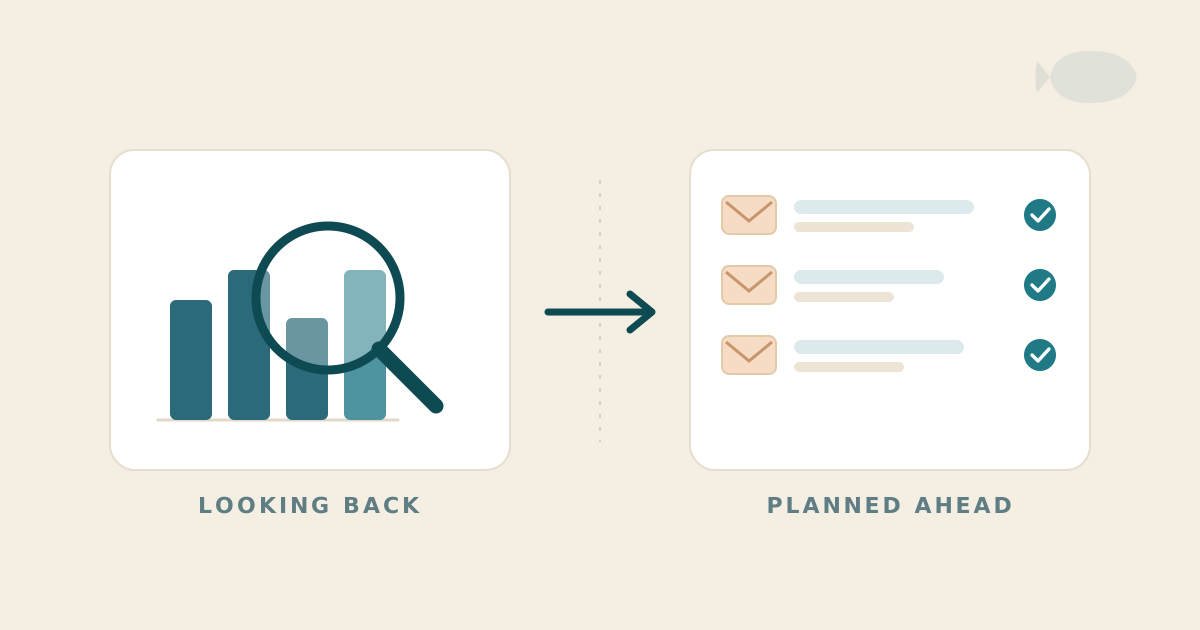
Mint had over 20 million users at its peak. It showed everyone exactly where their money went — clear charts, category breakdowns, spending trends by month. It was the most complete financial picture most people had ever seen of their own lives.
And it didn't change their spending.
This isn't a knock on Mint specifically. It's the fundamental problem with every tracking-first app: knowing what you did has almost no predictive power over what you'll do next. The research on this is not ambiguous.
The Gollwitzer Finding — and Why It Matters
In 1999, psychologist Peter Gollwitzer published research that became a landmark in behavioral science. He distinguished between two types of intentions: goal intentions ("I want to spend less on restaurants") and implementation intentions ("When I get paid on Friday, I will put $200 in my dining envelope and stop when it's gone").
The difference in outcomes was dramatic. Goal intentions had weak effects on actual behavior. Implementation intentions — specific plans that specified when, where, and how — produced behavior change two to three times more reliably.
Implementation intentions (specific pre-committed plans) vs. goal intentions (general desires to do better), per Gollwitzer 1999.
The reason is mechanical, not motivational. An implementation intention removes the in-the-moment decision entirely. You've already decided. When the situation arrives — payday, the restaurant menu, the Amazon cart — your response is already specified.
Tracking gives you data to form a goal intention. Envelope budgeting creates an implementation intention. They are not the same thing.
Reactive vs. Proactive — The Core Distinction
Every budgeting system falls into one of two camps.
Reactive systems record what happened. You spend money. The app logs it. At the end of the month, you see a pie chart. Mint was reactive. Most "spending tracker" apps are reactive. They're fundamentally backward-looking.
Proactive systems create decisions before spending happens. You get paid. You immediately allocate that money across categories. Before you spend a dollar, you've already decided which category it belongs to and how much that category has.
Tracking tells you what happened. Budgeting decides what will happen. Only one of those is a behavioral intervention.
The behavioral research on proactive vs. reactive framing is consistent: decisions made at a neutral, unhurried moment (budgeting on payday) produce better outcomes than decisions made in a charged, in-the-moment context (standing in a store, browsing a feed).
Why Alerts Don't Fill the Gap
Many tracking apps try to bridge this gap with notifications: "You've spent 80% of your restaurant budget." The theory is that alerts create a decision point at the critical moment.
In practice, this doesn't work well, for two reasons.
First, attention fatigue. Alerts compete with dozens of other notifications. After a few weeks, they're background noise. Behavioral science research on habit formation shows that stimulus-response loops built on notifications are fragile — they degrade quickly when the novelty wears off.
Second, the alert arrives at the worst possible moment. You're already at the restaurant, the meal is already ordered, the social context is already set. The decision that matters — whether to go to the restaurant at all — happened hours earlier. An alert when you're 80% through a budget can prompt guilt; it rarely prompts a different decision.
A pre-committed envelope budget eliminates this problem. The decision happened before the month started. The alert isn't trying to reverse a behavior — it's confirming a commitment you already made to yourself.
Pre-Commitment — The Most Effective Behavioral Finance Technique
Behavioral economists Richard Thaler and Shlomo Benartzi famously designed the Save More Tomorrow program around a single insight: people are better at committing to future behavior than changing present behavior. By asking employees to pre-commit future raises to retirement savings, participation and savings rates increased dramatically — not because people were more disciplined, but because the commitment happened at a non-temptation moment.
Envelope budgeting is pre-commitment applied to every spending category, every month.
When you allocate $300 to groceries on the 1st, you've made a commitment at a moment of calm, with full context, with no competing temptation. When you're standing in the cereal aisle on the 15th, you're not making a decision about groceries anymore — you made that decision two weeks ago. You're just executing it.
Pre-commitment works because it separates the decision from the temptation moment. You can't rely on willpower in the moment — it's depleted, it competes with other stimuli, it varies with mood. But a commitment made in advance doesn't require willpower at the point of spending. The decision is already made.
This is why the envelope method has a 70-year track record. It's not about cash. It's about pre-commitment made visible.
Where Passive Trackers Like Monarch Fall Short
Apps like Monarch are beautiful, well-designed spending trackers. They show you your cash flow, your net worth, your spending trends. For someone who wants a financial dashboard, they do it well.
But Monarch's model is fundamentally reactive. You can set category budgets, but the design is built around seeing what you did, not committing to what you will do. There's no allocation step at the beginning of the month. There's no moment of pre-commitment baked into the workflow.
If you're already a disciplined spender who just wants visibility, that's fine. But if you're trying to change your spending behavior — which is why most people download a budget app in the first place — passive tracking won't get you there.
What the Envelope Mechanism Actually Does
The envelope method creates pre-commitment in a concrete, visible way. Every dollar of your paycheck gets assigned to a named category before any of it gets spent. That assignment is your implementation intention.
The psychological effect isn't just about limits. It's about decision architecture. When you fund your envelopes on payday, you're running through every category your life actually requires — groceries, rent, car insurance, dining out, the haircut, the kids' activity — and making a conscious, deliberate decision about each one. That mental process, done once a month at a moment of clarity, replaces dozens of in-the-moment micro-decisions that are far more susceptible to bias and impulse.
Tracking apps skip this step entirely. They wait until after the decisions have been made to tell you what they were.
How LazeeFish Fits In
The reason we built an AI budgeting app around envelope budgeting instead of tracking is exactly this: the behavioral mechanism matters more than the dashboard.
The AI handles categorization — every transaction your bank imports gets routed to the right envelope automatically. You don't manually sort transactions. What you do do is fund your envelopes at the beginning of each month. That five-minute allocation step is the entire intervention. Everything else is administration.
The mental energy that tracking apps ask you to spend reviewing charts goes toward the one decision that actually changes behavior: how much does each category get this month?
The allocation step is the whole thing
Everything downstream — categorization, reports, balances — is useful information. But the causal mechanism is the monthly allocation. That's the implementation intention. Don't skip it in favor of passive dashboards.
Use AI to protect the allocation step
If categorizing transactions manually takes 20 minutes a week, most people stop doing it. Auto-categorization removes that friction entirely, so the only thing that requires your attention is the decision that actually matters.
What to Do Tonight If You Currently Only Track
You don't need to overhaul anything. Start with one month of proactive allocation:
- Open your last 3 months of spending history from your tracking app. Don't overthink it — you just need category averages.
- List your fixed monthly obligations (rent, utilities, loan payments). These are non-negotiable envelopes.
- List your variable spending categories (groceries, dining, entertainment, personal care, clothing). These are where the behavior change lives.
- Assign a dollar amount to each variable category. Be realistic — not aspirational. If you've been spending $400 on groceries, budgeting $200 will fail. Budget $380 and work down gradually.
- When you get paid next, allocate those amounts first, before any discretionary spending happens.
That's it. You've just created implementation intentions for every spending category. The chart you'll see at the end of next month will look different — not because you tried harder, but because the architecture changed.
For a deeper dive into how the envelope method works, the envelope method guide covers the mechanics step by step. Or if you want to understand why most budget apps fail at an even more fundamental level, the next post in this series goes there.
Frequently Asked Questions
Does tracking help at all?
Yes — awareness is the prerequisite for change, and tracking provides that. If you have no idea where your money goes, two months of tracking is a useful foundation. The mistake is treating tracking as the intervention rather than the diagnostic. Once you understand your patterns, the next step has to be proactive allocation — otherwise you're just watching the problem in higher resolution.
What's the difference between budgeting and tracking?
Tracking is reactive — it records what you spent after the fact. Budgeting is proactive — it assigns money to categories before you spend it. The behavioral difference is everything. Tracking gives you data. Budgeting creates a decision point before every purchase: "Do I have room in this envelope?" That question is what changes spending patterns. No tracking app can create that decision point retroactively.
Is envelope budgeting really that different from setting category limits?
Yes, in one critical way: pre-commitment. Setting a spending limit after the fact — adding a cap to a category you already exceeded last month — is aspirational. Pre-allocating your actual paycheck to envelopes before the month begins is a commitment device. The money is assigned. It has somewhere to go. That physical (or digital) act of allocation is what makes it binding, not just a target on a dashboard.
Envelope budgeting with AI categorization. $5/month, 30-day free trial.
Get Started Free →