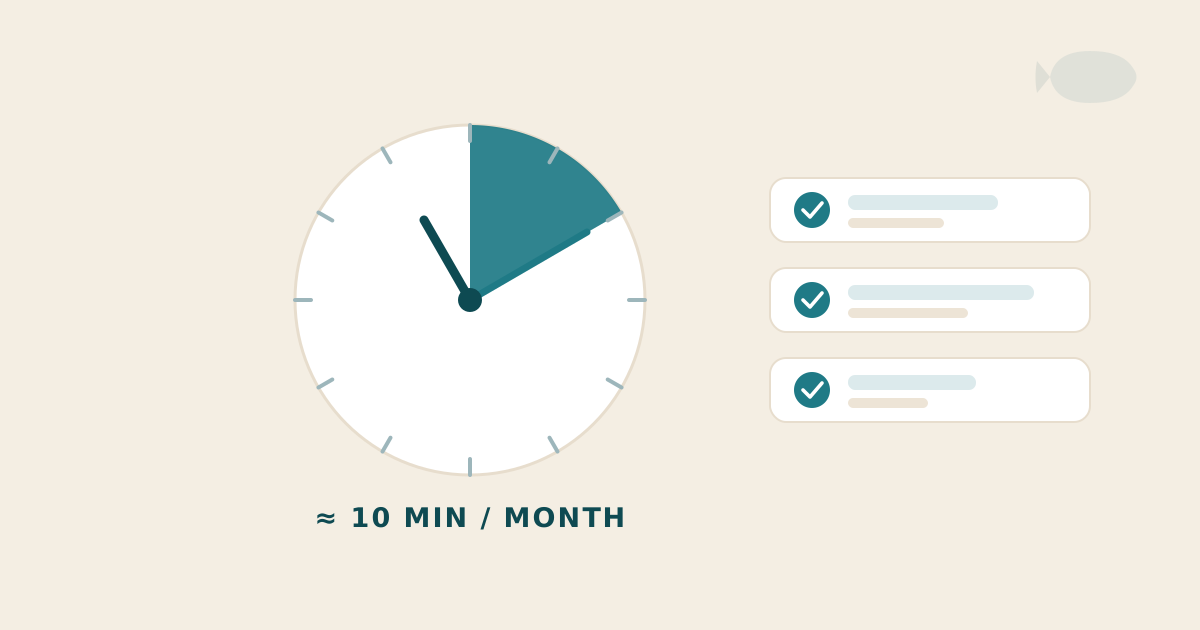
The most common reason people quit budgeting isn't the learning curve or the math. It's the time. "I tried YNAB but I couldn't keep up with it." That sentence shows up constantly in personal finance forums.
YNAB's approval queue — every incoming transaction waits for you to review, assign, and confirm it — is genuinely a significant time commitment. Their own community often cites 20–30 minutes per week as a realistic ongoing cost. That's roughly two hours a month, every month, just to keep the ledger current.
For a lot of people, that's a dealbreaker. Not because they don't want to budget, but because that's a second job they didn't sign up for.
Here's what the time commitment looks like when the app is designed around automation instead of manual approval.
The Actual Time Breakdown
First-time setup is a one-time 15-minute investment. Everything after that is ongoing maintenance — and most of it is automated.
Here's where those minutes actually go:
Monthly envelope funding: 5 minutes
This is the one task that can't be automated — and you wouldn't want it to be. Reviewing your envelopes and deciding how much each category gets this month is the entire behavioral mechanism. It's also the part that takes about five minutes once you know your patterns.
Reviewing auto-posted transactions: 2 minutes
When bank sync is connected, transactions import automatically and get categorized by AI. You're not approving each one — they're already in the right envelope. A quick skim to confirm everything looks right takes about two minutes, not twenty.
Fixing new merchants: 1–2 minutes
The first time a new merchant appears, the AI makes its best guess. If it's wrong, you correct it once. That merchant is remembered from then on. After the first month, almost everything is already mapped correctly.
First-time setup: 15 minutes, once
Connect your bank. Name your envelopes. Set initial amounts based on last month's spending. This is the upfront investment — and it happens exactly once. Everything after this is the 10-minute-per-month routine.
Where the Time Goes in YNAB — and Why That's a Legitimate Complaint
YNAB is built around a specific philosophy: every transaction should be touched by you. The argument is that manual review builds awareness. If you see every transaction, you stay engaged with your spending.
There's genuine merit to this. Awareness does matter — especially early in a budgeting journey when you're still forming habits. If you've never paid attention to how many small transactions accumulate, a manual queue is a useful (if temporary) shock to the system.
But awareness is a means to an end, not the end itself. After three months, you already know that you buy coffee most mornings and order takeout on Fridays. Manually approving those transactions for the 40th time doesn't add information — it just adds friction. And friction is what kills habits.
Manual transaction review makes sense as a phase — not as a permanent operating model. The goal is a budget you actually keep, not one you keep perfectly for eight weeks.
This isn't a criticism of YNAB's design philosophy — it's a real tradeoff. If you want maximum engagement with every dollar and you have the time, YNAB delivers that. If you want the behavioral benefits of envelope budgeting without the ongoing time tax, the design has to be different. See our full LazeeFish vs. YNAB comparison for the full breakdown.
How AI Removes the Time Cost
The time-consuming parts of budgeting — in any app — are the parts that involve moving data. Importing transactions. Matching them to categories. Approving them one by one. These are clerical tasks, not financial decisions.
AI auto-categorization handles all of this. When your bank account syncs, transactions are classified and posted to the correct envelope automatically based on the merchant, amount, and your own history. There's no queue to process. They're already filed.
The first month has the most manual corrections — merchants the system hasn't seen before, categories that needed fine-tuning. By month two, most households find that 95% of transactions are categorized correctly on import. By month three, it's essentially automatic.
This is the key design difference: the AI handles the data entry so your attention goes to the one decision that actually matters — how much does each envelope get this month.
The Setup Investment vs. the Ongoing Cost
Most people dramatically overestimate the setup time and underestimate the long-term payoff.
The first time you set up an envelope budget, it feels like a lot. You're creating categories from scratch, guessing at amounts, connecting bank accounts, waiting for transaction history to import. It takes 15 minutes, maybe 20 if you're thorough. That's real time.
But that's a one-time cost. After that, every month of the system costs about 10 minutes. Over a year, that's two hours total — less than a single YNAB-style maintenance week. Over three years, you're still under ten hours of cumulative time managing your entire financial life.
Compare that to the alternative: not budgeting, continuing to wonder where the money went, discovering at the end of the month that the numbers don't add up. That costs more time — it just costs it in stress and in Sunday evening dread rather than in a visible ledger entry.
The "10-Minute Month" as a Promise
We use this framing deliberately: the 10-minute month isn't a marketing claim about how fast our app is. It's a design constraint. Every feature decision we make asks whether it adds value worth more than the time it takes. If a feature requires manual review that automation could handle, we automate it. If a workflow has unnecessary steps, we remove them.
The goal is a budget that fits in the margins of a real life. Most people aren't reluctant to budget because they don't care about their money. They're reluctant because every previous attempt made them feel like they were failing at a part-time job. The fix isn't better willpower — it's better design.
- Open the app on payday (~5 min to fund envelopes)
- Skim auto-imported transactions to confirm they look right (~2 min)
- Fix any miscategorized merchants, which are remembered forever (~1–2 min)
That's it. Everything else — importing, categorizing, posting, reconciling — happens automatically in the background.
What to Do If You've Quit Before Because of Time
If you quit YNAB or another app because the upkeep felt overwhelming, that's a completely valid reason. The app's design required more time than your life had space for. That's not a character flaw.
The question is whether the design needs to be that way — or whether it's a historical artifact of apps built before good auto-categorization existed.
Start a 30-day trial. Connect one bank account. Set up five envelopes to start — rent, groceries, dining out, transportation, and everything else. Fund them from your next paycheck. Then do nothing else for a week and see what auto-imports.
By the end of week one, you'll have a clear picture of how much manual effort the system actually requires. For most people, it's a lot less than any previous budgeting experience suggested was possible.
For more on the behavioral side of why this system works — not just the time efficiency — the companion post on why tracking doesn't change behavior covers the psychology.
Frequently Asked Questions
How much time does YNAB take per month?
YNAB's community commonly reports 20–30 minutes per week, largely in the import queue — though YNAB auto-approves matched transactions, so that queue is smaller than this post once implied. That's roughly 90–120 minutes per month of ongoing maintenance — not counting setup. For households with high transaction volumes or multiple accounts, it's often more. This is the most commonly cited reason for leaving YNAB, more than the price or the learning curve.
Is daily budgeting better than monthly?
Daily check-ins build awareness, but they're not necessary for the envelope method to work. The method's behavioral mechanism is the monthly allocation — assigning your paycheck to envelopes at the start of the month. Once that's done, you only need to check in when you're unsure if an envelope has room. Most people find a quick weekly glance sufficient between allocations, but even that's optional if you have a rough sense of your envelope balances.
What if I miss a month?
Skip it and start fresh on the next payday. Don't try to retroactively reconcile a missed month — that turns a 10-minute task into an hour of archaeology, which is exactly what makes people give up. The envelope balances may be off, but the important thing is to re-establish the monthly allocation habit. Set new amounts, fund them from your next paycheck, and move forward. Perfection is the enemy of a working system.
10 minutes a month. 30-day free trial. No card required to start.
Get Started Free →